

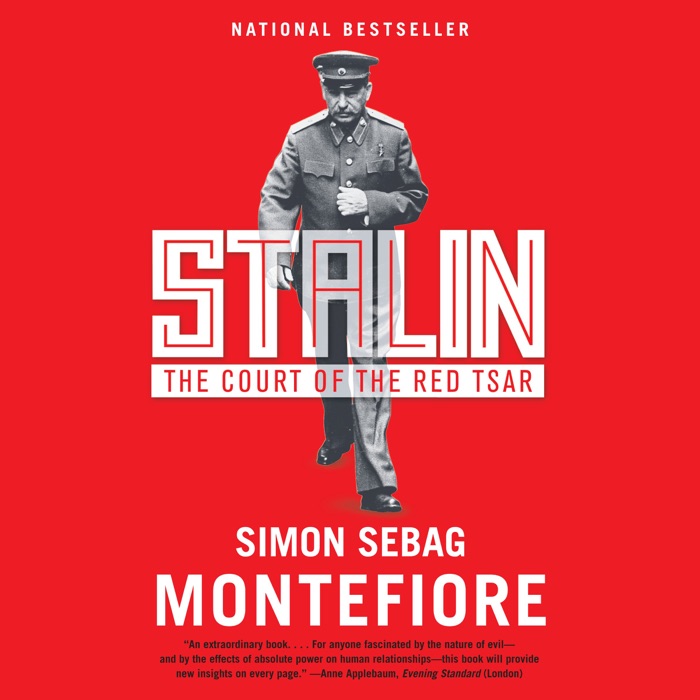
Stalin: The Court of the Red Tsar (Unabridged)
Price:- $24.99
Product Summery
Fifty years after his death, Stalin remains a figure of powerful and dark fascination. The almost unfathomable scale of his crimes–as many as 20 million Soviets died in his purges and infamous Gulag–has given him the lasting distinction as a personification of evil in the twentieth century. But though the facts of Stalin’s reign are well known, this remarkable biography reveals a Stalin we have never seen before as it illuminates the vast foundation–human, psychological and physical–that supported and encouraged him, the men and women who did his bidding, lived in fear of him and, more often than not, were betrayed by him.
In a seamless meshing of exhaustive research, brilliant synthesis and narrative élan, Simon Sebag Montefiore chronicles the life and lives of Stalin’s court from the time of his acclamation as “leader” in 1929, five years after Lenin’s death, until his own death in 1953 at the age of seventy-three. Through the lens of personality–Stalin’s as well as those of his most notorious henchmen, Molotov, Beria and Yezhov among them–the author sheds new light on the oligarchy that attempted to create a new world by exterminating the old. He gives us the details of their quotidian and monstrous lives: Stalin’s favorites in music, movies, literature (Hemmingway, The Forsyte Saga and The Last of the Mohicans were at the top of his list), food and history (he took Ivan the Terrible as his role model and swore by Lenin’s dictum, “A revolution without firing squads is meaningless”). We see him among his courtiers, his informal but deadly game of power played out at dinners and parties at Black Sea villas and in the apartments of the Kremlin. We see the debauchery, paranoia and cravenness that ruled the lives of Stalin’s inner court, and we see how the dictator played them one against the other in order to hone the awful efficiency of his killing machine.
With stunning attention to detail, Montefiore documents the crimes, small and large, of all the members of Stalin’s court. And he traces the intricate and shifting web of their relationships as the relative warmth of Stalin’s rule in the early 1930s gives way to the Great Terror of the late 1930s, the upheaval of World War II (there has never been as acute an account of Stalin’s meeting at Yalta with Churchill and Roosevelt) and the horrific postwar years when he terrorized his closest associates as unrelentingly as he did the rest of his country.
Stalin: The Court of the Red Tsar gives an unprecedented understanding of Stalin’s dictatorship, and, as well, a Stalin as human and complicated as he is brutal. It is a galvanizing portrait: razor-sharp, sensitive and unforgiving.

.png)